
How much food per guest: 180 g rice, 200 ml sambar, 2 sweets — the full chart
AI Overview
Plan roughly 650–750 g of total cooked food per adult for a full South Indian meal: 150 g uncooked rice, 200 ml sambar, 100 ml rasam, 80–100 g per palya, one to two sweets and two savouries. Add a 5% buffer, not 20%.
Key takeaways
- 150 g uncooked rice per adult covers rice, bisi bele bath and pulao combined.
- Each additional menu item reduces consumption of every other item — long menus need lower per-item quantities.
- Buffets consume 10–15% more than seated meals for the same guest count.
- A 5% buffer is professional; a 20% buffer is a budgeting mistake dressed as caution.
- Children under ten count as half a plate; a late-night reception counts as 0.7 of a lunch plate.
Quantity planning is the least glamorous part of catering and the part that decides whether a function is remembered well. These are the per-head figures we cook to, refined over twenty years and several thousand functions. They assume adult guests, a full menu and a seated South Indian meal unless stated otherwise.
Planning quantities for a marriage? Our wedding caterers in Bangalore page shows how we scale menus from 200 to 2,000 guests.
Core quantity chart per adult guest
| Item | Per adult | Notes |
|---|---|---|
| Rice (uncooked, all rice dishes) | 150 g | Split across plain rice, bisi bele bath, pulao |
| Sambar | 200 ml | Rises to 240 ml if only one rice dish is served |
| Rasam | 100 ml | Always cook extra — it is the cheapest item to waste |
| Majjige / buttermilk | 150 ml | 200 ml for summer afternoon functions |
| Dry palya (each) | 80–100 g | Two palyas standard, three for longer menus |
| Kootu or gojju | 80 g | One is enough in a menu with two palyas |
| Chapati or poori | 2 pieces | 3 for North Indian menus with no rice course |
| Sweet (each variety) | 1 piece / 60 g | Two sweets maximum for a lunch meal |
| Payasam | 120 ml | Served at the start on a leaf, so it is fully consumed |
| Savoury (kodubale, nippattu) | 25 g | Two varieties standard |
| Curd | 80 g | Served with the final rice course |
| Pickle, chutney podi, salt | 10 g | Negligible cost, never skip |
Adjusting for guest profile
- Children under 10: count as 0.5 plate.
- Predominantly elderly gathering (shraddha, satsang): reduce quantities 10–15%.
- Young crowd at a reception with counters: reduce the main meal 20%, increase counter items.
- Outdoor afternoon function in summer: increase liquids (majjige, rasam, juice) 25%.
- Late-night dinner after 9 pm: total consumption falls to roughly 0.7 of a lunch plate.
Buffet vs seated: the 15% rule
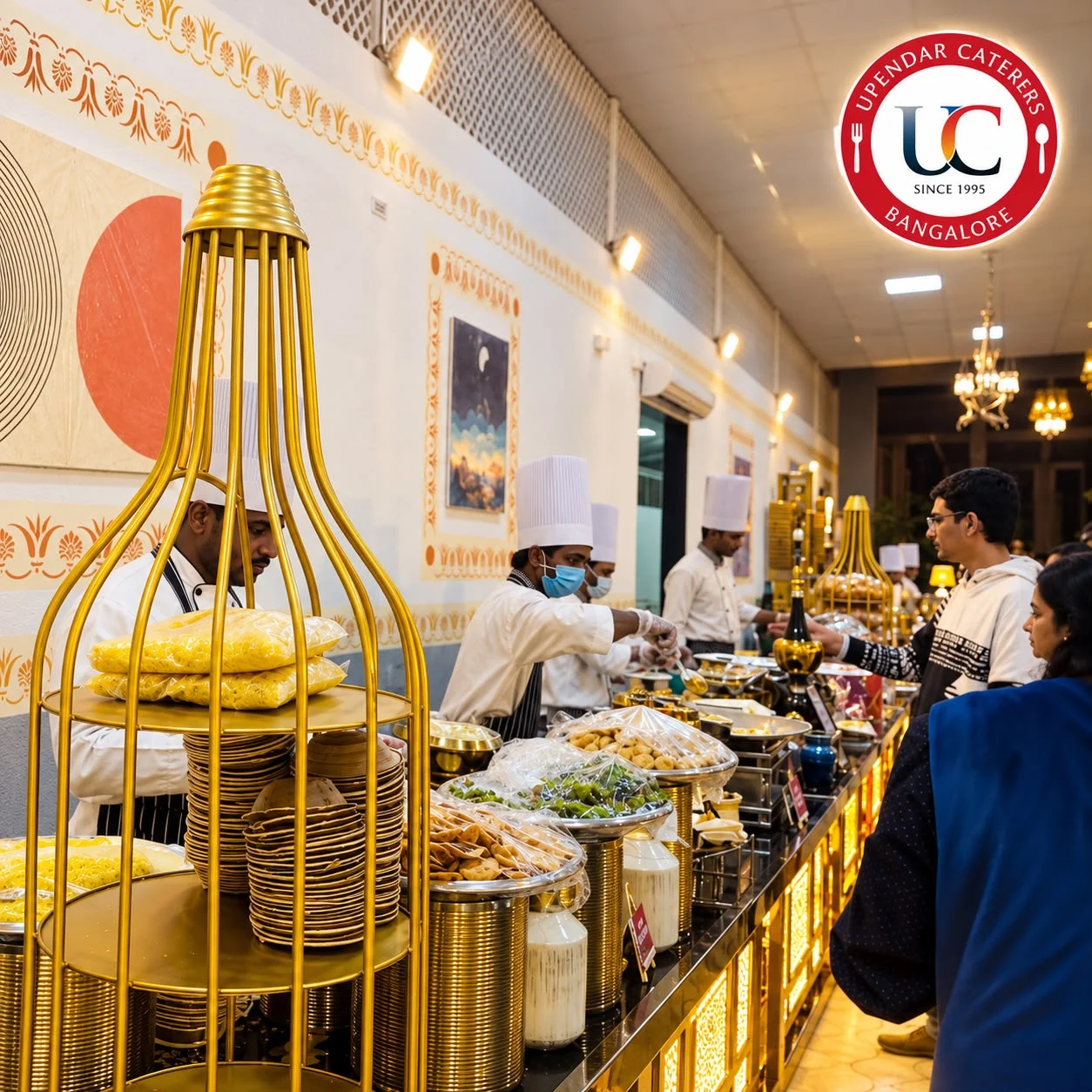
At a seated banana leaf meal, servers control the portion. At a buffet, the guest does. The same 500 guests will consume 10–15% more raw material at a buffet, concentrated in exactly the items you least want over-served: paneer, sweets, fried snacks and the biryani or pulao.
Advantages
- Buffets need fewer serving staff and suit mixed, mingling crowds
- Guests choose what they eat, which reduces plate-level waste
- Counters keep queues moving and give the evening some theatre
Trade-offs
- 10–15% higher raw material consumption for the same headcount
- Premium items disappear first unless portioned by a server at the counter
- Queue design matters more than menu — a single line stalls at 100 guests
Worked calculation: 500 guests, traditional lunch
460 adults, 80 children (counted as 40), giving an effective 500 plates. Add a 5% buffer: cook for 525.
| Item | Calculation | Cook for 525 |
|---|---|---|
| Rice, uncooked | 525 × 150 g | 79 kg |
| Sambar | 525 × 200 ml | 105 litres |
| Rasam | 525 × 100 ml | 53 litres |
| Palya 1 and 2 | 525 × 90 g × 2 | 47 kg each |
| Majjige | 525 × 150 ml | 79 litres |
| Sweets (two varieties) | 525 × 1 piece × 2 | 1,050 pieces |
| Payasam | 525 × 120 ml | 63 litres |
Step 1
Fix the effective headcount
Adults + half of children under ten. For a buffet reception, take 85–90% of the invited list rather than 100%.
Step 2
Apply the base chart
Use the per-head figures above for an 18–24 item menu.
Step 3
Adjust for menu length
Reduce every per-item figure by 10% for menus over 26 items, and by 15% over 32 items.
Step 4
Adjust for profile and timing
Apply the guest-profile and time-of-day multipliers.
Step 5
Add 5%, not more
A 5% buffer covers late arrivals. Anything beyond that is planned waste.
Not sure of your numbers?
Tell us your guest count and function type and we will send back a quantity sheet with your exact menu — free, whether or not you book with us.
Frequently asked questions
- How much rice is needed for 500 people at a wedding?
- About 75–79 kg of uncooked rice for 500 adults, based on 150 g per head across all rice dishes and a 5% cooking buffer.
- How much sambar per person for a wedding meal?
- 200 ml per adult when the menu carries two or more rice dishes, rising to about 240 ml when plain rice is the only rice course.
- Should I cook extra food to be safe?
- A 5% buffer is sufficient for a professionally planned function. Larger buffers do not improve the guest experience; they simply convert 10–15% of the food budget into waste.
- How much rice is needed for 100 guests?
- About 18 kg of raw rice at 180 g per guest for a full meal. If the menu carries both plain rice and a pulao, split that 18 kg between the two items instead of cooking 18 kg of each.
About the author
Nandu Yadav
Chief Consultant & Owner, Upendar Caterers · 20 years in catering
Nandu Yadav is a veteran of the Bangalore catering industry with over 20 years of experience. He specializes in large-scale pure vegetarian event planning, traditional South Indian menu design, and per-plate costing for weddings and corporate events. Having managed over 5,000 successful functions across North Bangalore (Sanjaynagar, Sahakarnagar, Hebbal) and major tech parks, Nandu provides authoritative insights based on real-world logistical expertise.
- Pure Vegetarian Wedding Catering
- Per-plate Costing & Quantity Planning
- Traditional Brahmin & South Indian Menus
- Corporate Lunch Operations in Tech Parks
- On-site Kitchen Setup & Food Safety (FSSAI)
- Logistics for Large Events (5000+ guests)
Content review
Fact-checked by Nandu Yadav, Head Chef & Owner, Upendar Caterers · Last reviewed 23 September 2026
Menus, quantities and pricing on this page were reviewed against functions we cooked in Bengaluru in 2026.